
Data Governance

Content coming soon

This factsheet is currently being prepared by the Responsible Science team. It will provide an overview of the topic, explain its relevance to responsible research, and include practical guidance and further resources.

We appreciate your patience as we continue to develop the website.

Equity, Inclusion & Benefit Sharing

Content coming soon

This factsheet is currently being prepared by the Responsible Science team. It will provide an overview of the topic, explain its relevance to responsible research, and include practical guidance and further resources.

We appreciate your patience as we continue to develop the website.

Dual-Use, Misuse & Security Risks

Content coming soon

This factsheet is currently being prepared by the Responsible Science team. It will provide an overview of the topic, explain its relevance to responsible research, and include practical guidance and further resources.

We appreciate your patience as we continue to develop the website.

Introduction to Intellectual Property

By Dr Hamish MacDonald, University of Queensland Law School

Intellectual property (IP) is a category of legal rights that covers intangible things created by an individual or organisation. IP rights can be used to prevent others from using these intangibles without your permission. Permission is granted through explicit and implicit licenses that allow the use, rent, or transfer – in whole or in part – of the intangible asset in question.  

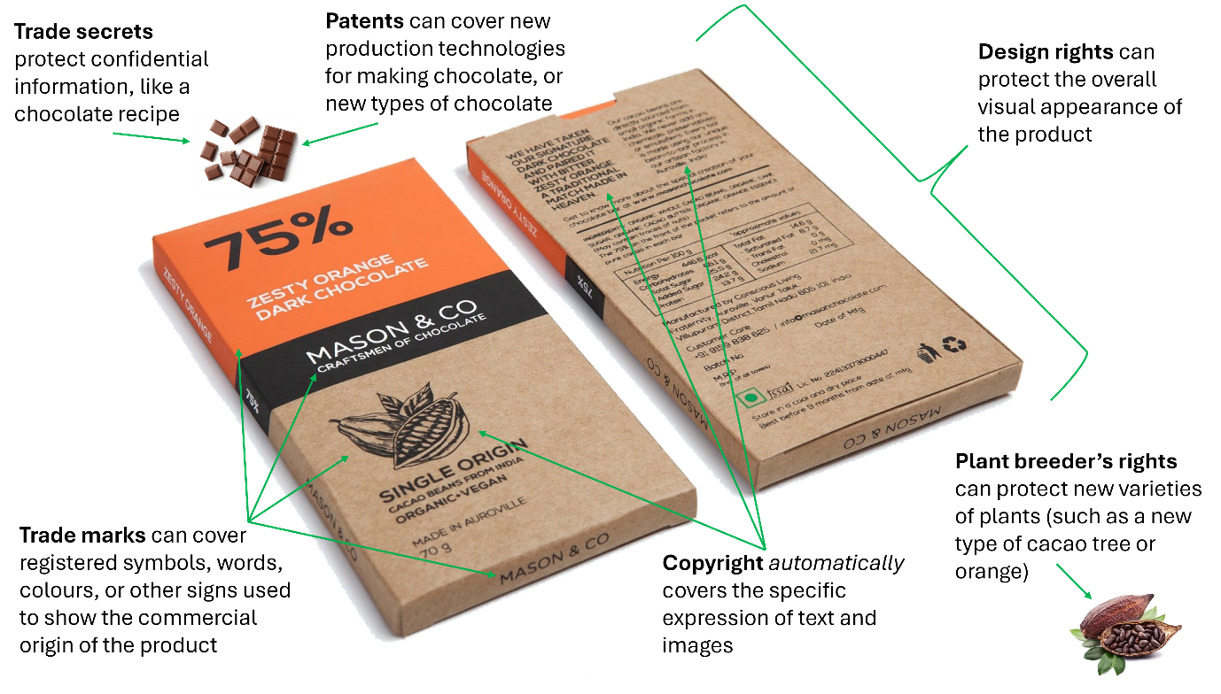
There are a range of different types of intellectual property that may be relevant to researchers and research organisations. This factsheet aims to provide an overview of the main uses of each form of IP protection. 

It is important to emphasise that IP rights are created and administered at the national level. While the types of IP rights are largely the same across the world, there are important local differences in their implementation, and they must be registered in each relevant jurisdiction where protection is desired (with the exception of copyright, which is automatic).


Types of Intellectual Property

  • Copyright protects creative expressions, including writing, images, and computer code. Copyright automatically covers original creative works, until 70 years after the death of the author. 
  • Patent protects inventions which are novel, useful, and which contain an inventive step. They provide strong protection for a period of 20 years, but are expensive and complex. 
  • Trade marks protect signs indicating a brand or commercial origin. 
  • Trade secrets protect confidential information about a business. 
  • Design rights protect the overall visual appearance of a physical product. 
  • Plant breeder’s rights protect new varieties of plants. 


Summary

Type of IP  What is Protected  Cost  Timeline for Grant  Duration  Strategic Considerations 
Copyright  Specific creative expressions   Free  No grant required  70 years after the death of the author  Only protects the specific expression (only prevents direct copying) 
Patents  Inventions which are novel, useful, and non-obvious.  $10,000 -$20,000  6 months to several years  20 years  Provides strong protection over an invention 
Trade marks  Distinctive symbols (including words, sounds, colours, etc.) associated with a brand  Minimum $250 filing fees (not including lawyer fees)  Minimum 7 months  10 years per registration, can be renewed indefinitely  Provides powerful and indefinitely 

Only protects within categories of goods or services for which it is registered 

Trade secrets  Confidential information 

Breach of confidence is a legal action which provides protection when secrets are leaked 

Practical costs of secrecy  No grant required  No limit, unless secret becomes public  For legal protection to be available, secrecy measures must be in place 
Design rights  The overall visual appearance of a whole physical product  Minimum $250 filing fee; lawyer fees ~$1000  Within 6 months  5 years, with the option of renewal for an additional 5 years  Provides quite limited protection over a specific design 
Plant Breeder’s Rights  New varieties of plants  $3000+  2 to 3 years  20 years (25 for trees and some vines)  Only covers plant varieties 

Copyright

By Dr Sruthi Balaji, University of Queensland School of Law

Copyright is a set of rights granted by the government to protect the particular form, way, or manner in which information or concepts are expressed. Copyright does not protect ideas, concepts, styles, techniques, or information, but rather the form in which these things are expressed. Other subject matter that is not able to be protected with copyright includes names, titles, slogans, people, and people’s images.  

Copyright is administered and enforced on a country-by-country basis. In Australia, the relevant law is the Copyright Act 1968. Owners of copyright have several exclusive rights to control the use of their material and different rights apply to different types of material. Anyone who wants to use the copyrighted material needs to obtain permission from the copyright owner. 

Although copyright laws are enforced nationally, international copyright treaties have resulted in broadly consistent protection across signatory countries, including mutual recognition of copyright and a copyright right term that generally lasts for the life of the creator plus 70 years.  

Copyright protection generally extends to two categories of material: ‘works’ and ‘other subject matter’. 

Examples of works include: 

  • Literary works – i.e. the written word, including books, journal articles, instruction manuals, reports, computer programs and databases. 
  • Artistic works – includes paintings, drawings, cartoons, sculptures, diagrams, buildings, photographs and maps. 
  • Dramatic works – includes choreography (dance), screenplays, plays and mime pieces. 
  • Musical works – includes music itself, separate from any lyrics or sound recordings, 

The ‘other subject matter’ category covers sound recordings, films, and TV and radio broadcasts. 


Criteria for Copyright Protection

Copyright protection is free and automatic. There is no need to apply in Australia as there is no system of registration.  

To qualify for copyright protection, a work must be ‘original’. For the purposes of copyright, original simply means that the work has not been copied from another source. 


Why is it relevant?

Copyright is relevant to researchers because it governs how research outputs can be used, shared, and reused. Many common research materials, such as journal articles, images, datasets, software code, and teaching resources, are protected by copyright automatically when they are created. Understanding copyright helps researchers use third-party materials appropriately, share their own work under suitable terms, and navigate publishing agreements with journals or other publishing outlets. For example, researchers may choose to share their outputs under open licences such as those developed by Creative Commons, which allow others to reuse material under specified conditions. 

It is also important in collaborative and institutional research settings, where questions may arise about authorship, ownership, and how and when research outputs can be disseminated or reused.  


Practical Steps

  1. Understand who owns copyright. Copyright automatically protects many research outputs. Works created by employees in the course of their employment may be owned by their employer, subject to institutional policies. Check your institution’s policies to understand ownership arrangements. 
  2. Clarify rights in collaborations. When working with collaborators from other institutions or with external partners, discuss authorship, copyright ownership, and how research outputs may be shared or reused. 
  3. Check permissions when using third-party material. If you want to reuse figures, images, tables, or other works created by others, check whether permission is required. Some works may be available under open licences such as those developed by Creative Commons, which allow reuse under specific conditions. 
  4. Check publishing agreements carefully.  Academic publishers sometimes require authors to transfer copyright as part of the publication process. Before signing, check whether you can retain certain rights, such as sharing your work in an institutional repository or reusing it in future research and teaching. 

As with all intellectual property issues, your institution’s intellectual property office should be able to clarify and assist with any copyright related matters that come up in the course of your work.  


Case Study

In Australia, the use of copyrighted material to train AI models is a subject of ongoing debateThe Australian Government has definitively ruled out introducing a text and data mining exemption, and so there will be no carve out for AI developers to train their models on Australian creative worksNow, various other reforms are being debated such as the implementation of a collective or voluntary licensing framework. This case highlights the challenge of updating copyright rules to keep pace with emerging technologies such as generative AI. [1] 
Freedom to Operate

By Dr Hamish MacDonald, University of Queensland Law School

Freedom to operate is the process of ensuring that you are not infringing on intellectual property rights belonging to others. Where commercialisation is a goal, it consists of confirming that you will be able to sell your product or service without the possibility of another party making a legal claim against you.  


Why is it relevant?

It’s important that freedom to operate is checked early in the innovation process. If intellectual property (IP) infringement is proven against you, you will need to pay an ‘account of profits’ to the IP owner – a share of the profits that you have made. If an invention has been in the market for many years, this could be a substantial sum of money. An IP infringement claim might also require you to rebrand your business. Uncertainty in IP ownership may also be treated as a liability by potential business partners and investors. 

It is worth emphasising that IP rights are specific to each country. That means that you will need to check your freedom to operate for each country that you are intending to trade in. 


Practical Steps

  1. Freedom to Operate: Copyright.Because copyright infringement requires direct copying, avoiding copyright infringement just means not copying the direct expressions of your competitors.  As long as you have not directly copied a work (including text, images, photographs, as so on), copyright will not interfere with your freedom to operate. Innocent infringement is a defence to a copyright infringement claim: as long as you can prove you created something yourself, accidental similarities to pre-existing works are not a problem. To avoid copyright infringement claims, avoid using works that you did not create yourself, unless you have permission from the original creator. As the copyright status of AI-generated works is legally uncertain at present, it is best to not use AI for important elements of your business. 
  2. Freedom to Operate: Trade Marks.Innocent infringement is not a defence for trademark infringement. That means that even if you didn’t know a trade mark existed, you can still be found to have infringed that trade mark. To help avoid this happening, it is best practice to perform a trade mark search using IP Australia’s free search tools. IP Australia offers two kinds of free trade mark search. The Quick Search tool allows searching for words in the trade mark, the name of the owner, the trade mark number, or for an image. [1] Note than only exact matches will be returned. The Advanced Search provides a much more powerful search tool. [2] Searches can include multiple words and images, phrases, trade mark classes, trade mark status, dates, owners, trade mark number, and various other fields. The Advanced Search also provides search features including phonetic similarity, partial match, and fuzzy (approximate) match. IP Australia also provides a Trade Marks Classification Search tool, which is useful for identifying the classification of your trade mark to narrow down your search results. [3] Even if you are not intending to obtain a trade mark yourself, you should do a trade mark search for key elements of your business. Your most comprehensive searches should be around your business name, product name, and logos. It can also be worth searching in your commercial categories for things like logos, packaging, colours, and fonts, although the risk of accidentally infringing these is much lower than names. 

    Filing for your own trade mark can be an effective defensive move against trade mark infringement. This is because trade mark searches and determinations are made during the application process. Once this is registered, the owner’s rights in the trade mark are legally protected. Alternatively, if the trade mark is rejected, at least the cost of rebranding a business is averted.

  3. Freedom to Operate: Patents.For patents, unlike copyright, innocent infringement (independent creation) is not a defence. There are a number of useful websites for patent searching. Lens.org allows quick searching by keyword or patent field, [4] and structured searching by a large number of fields, including jurisdiction, key dates, inventor, classification, and various text searches. [5] Searching keywords and synonyms relating to your possible new product or technology can be extremely valuable for saving time that may have been spent developing something which already exists. Patent searching can also be useful for identifying elements of a competitor’s business which you may be free to copy. Patent searching can also be useful for staying up to date on developments in your industry, for keeping up with the state of the technological art, and for generating ideas about your own innovative products and technologies. 

    It is worth searching for any key innovations in your business processes or products. Because of the large number of ways that an invention can be described, it is worth engaging a lawyer if you are concerned that you may be infringing a patent.  

Contracts

By Dr Hamish MacDonald, University of Queensland Law School

Contracts are an extremely important legal tool. A contract is a binding agreement between two or more parties (persons or organisations).  

To create a legally binding contract, a few things are necessary. A contract requires an offer to be communicated to a party, followed by unambiguous acceptance being communicated back to the offeror. A contract must be legally permissible, and cannot include illegal activities. There must be valuable consideration on both sides, meaning that each party receives and gives up something of value (though this does not have to be equal value. There must be sufficient certainty surrounding the key terms of the contract. Finally, any additional legislative formalities must be complied with. For example, there is no general requirement that a contract has to be in writing, but certain types of contracts (such as the sale of a business) have additional legislation which requires contracts to be in writing. In practice, it is highly advisable that all contracts are in writing, as verbal contracts are difficult to prove and enforce. 

If a contract is breached, the normal way this is addressed by courts is to award monetary compensation to the party who suffered financial losses due to the breach of contract. The goal is to put the injured party into the financial position they would have been in if the contract had not been breached. However, if a term is deemed to be an “essential term” of the contract, also known as a “condition”, the non-breaching party may have the right to terminate the contract. A contract may also be terminated or rescinded if a court finds that its formation involved misrepresentations, misleading or deceptive conduct, duress, undue influence through a relationship of power, or other unfair or unreasonable conduct. 

It is important to note that unlike intellectual property, contracts can only be enforced against the person who made the contract. For example, if somebody breaches a confidentiality agreement and gives your idea to a competitor, you would have no legal course of action against the competitor. Because of this limitation, contracts and intellectual property are frequently used together to control the circulation of important information. Contracts provide more powerful, flexible, and fine-grained control over information, while intellectual property rights provide protection in case the information ends up escaping the contractual relationship. 


Examples of common types of contracts 

  • Employment contracts: set out employment rights and responsibilities. Often include terms relating to the ownership of intellectual property 
  • Non-disclosure agreements: restrict parties from sharing confidential information. Frequently used when ideas are disclosed to other parties at an early stage of development. 
  • Open access licences: allows free access to intellectual property, and may impose conditions on subsequent reuse (such as disallowing commercialisation of any derivatives). 

Why is it relevant?

Contracts play a crucial role in the practical management of intellectual property. A licence is a type of contract which allows one party to use an asset which belongs to another party. All forms of intellectual property can be licenced to or from other parties.  

If a researcher or research organisation develops valuable IP, commercialising it in-house is not the only option available. Instead, this IP can be licenced to another business. This is generally a less risky option, although it does involve ceding some amount of control over the commercialisation process, and potentially some of the profits. Another option is to make this intellectual property freely available to the public through an open access licence. 

In collaborative research, such as multi-institutional quantum biology projects or partnerships between universities and biotech firms, contracts play an important role in determining who owns any intellectual property that arises from the collaboration. Without a clear agreement in place, disputes over IP ownership can delay or prevent the commercialisation of research outcomes. Key issues to address upfront include which party owns foreground IP (new IP generated during the project), how pre-existing background IP can be used by collaborators, whether ownership is shared or allocated to a single party, and what rights each party retains to use the results for future research or commercial purposes. 


Practical Steps

  1. Enter into a contract. A legally enforceable contract can be formed by meeting the requirements detailed above. For important contracts, it is advisable to use a lawyer to draft the contract. 
  2. Contact your institution. Before entering into any significant contract, such as a collaboration agreement, licence, or non-disclosure agreement, researchers should contact their institution’s technology transfer office or research contracts office. These teams have experience negotiating terms that protect the institution’s interests, and can help identify potential issues before they become problems. 

Case Study

The full Federal Court of Australia upheld a decision that found the intellectual property rights of an invention developed by professor of surgery Dr Gray belonged to Dr Gray, not the University of Western Australia.[1] In reaching this conclusion, the Court examined the contract of employment that stipulated he was to conduct research, teach and conduct examinations, but contained no express obligation to invent. The contract also did not contain any express or implied terms relating to the ownership of intellectual property rights. This case highlights the importance of clear contractual terms within employment contracts between university and academics. [2] [3]

Trade Marks

By Dr Sruthi Balaji, University of Queensland School of Law

A trade mark acts as a shortcut to allow consumers to efficiently identify the nature, quality, and source of a product or service. It is a sign that identifies and distinguishes the goods or services of one trader from those of another. In this way, trade marks are valuable assets that can act as a ‘badge of origin’, and that can help to build a business’s profile, develop its reputation, and achieve its commercialisation objectives. Some of the most familiar trade marks worldwide are Apple, Microsoft and Google. In the context of quantum and biotechnologies, recognisable trade marks include IBM, Q-CTRL and SQC. In Australia, trade marks are registered under the Trade Marks Act 1995 (Cth). 

Trade marks typically consist of names and/or logos that are applied to goods, or used in relation to services, but they can also be a letter, number, phrase, sound, smell, shape, picture, movement, aspects of packaging, or a combination of these. To receive protection under the Trade Marks Act, the trade mark must be registered under the Act. In Australia, a trade mark registration lasts for 10 years and can generally be renewed indefinitely for further 10 year periods. Protection for unregistered trade marks is available under the law of “passing off” or consumer protection legislation. 

In addition to standard trade marks there are several other categories of marks. These include: 

  • Collective trade marks may be granted to an association or collective group, and used by members of that group to distinguish their goods or services based on their association with that group; 
  • Certification trade marks show that a trader’s goods or services are certified as meeting particular standards. Certification marks may be granted to anyone who can verify that his or her goods or services meet established standards related to quality, origin, or some other characteristic; and 
  • Well-known trade marks are marks that have a high degree of consumer recognition. Significantly, well-known marks do not need to be registered in a particular class of goods or services to receive protection in that class. 

Criteria for Trade Mark Protection

When a trade mark is registered under the Act there is a presumption of registrability. This means that if the application was made in accordance with the Trade Marks Act, the mark will be accepted unless there are grounds to reject it. 

Grounds for refusing or rejecting a trade mark application include: 

  • Lack of distinctiveness – that the average consumer would not understand the mark as indicating the trade origin of the goods. 
  • The mark applied for is likely to mislead, deceive or confuse consumers; and 
  • The mark applied for is substantially identical with or deceptively similar to an earlier registered trade mark or trade mark application for identical or similar goods or services.  

Why is it relevant?

Trade marks are relevant to researchers and research institutions primarily in the context of commercialisation and industry partnerships. While trade marks do not protect scientific discoveries or technologies themselves, they protect the brands used to identify products or services in the marketplace. Universities, research institutes, and spin-out companies may use trade marks to distinguish products, services, programs, or platforms that emerge from research. Understanding trade marks can therefore be useful when research is translated into commercial applications, when institutions develop branded research initiatives or services, or when collaborating with industry partners who rely on trade marks to identify their goods and services. 


Practical Steps

  1. Be mindful when naming projects or tools
    If you are developing a research tool or product with a public-facing name, check whether similar names are already being used or have been registered as trade marks. 
  2. Avoid using trade marks owned by others in ways that may cause confusion
    When referring to commercial products, software, or technologies in publications, presentations, or outreach materials, use trade marks accurately to avoid any suggestion of endorsement or affiliation where none exists. 
  3. Discuss branding and commercialisation early
    If research outputs are likely to be commercialised, trade marks may be relevant for branding. Early discussions with your institution’s commercialisation office can help identify the appropriate avenues. 
  4. Check institutional policies and seek advice when needed
    Universities and research organisations often manage trade marks associated with institutional research. If a project name or brand is intended for broader use, consult your institution’s legal or commercialisation team. 

Case Study

Meta successfully opposed an Australian startup’s attempt to register the trade mark “ReelStar” for services including social media marketing and video transmission. The Registrar of Trade Marks found that the name was too similar to Meta’s short-form video feature “Reels”, and that its use could be likely to deceive or cause confusion. As a result, the trade mark registration was refused. [1]

This case highlights the importance of conducting thorough trade mark searches before launching a new brand. Failing to consider existing trade marks can lead to legal challenges, delayed launches, or the need to rebrand.

Patents

By Dr Sruthi Balaji, University of Queensland School of Law

Patents are legally enforceable rights that are granted by a national government’s intellectual property authority. This is IP Australia within Australia. Patents are granted to inventors for new and useful inventions. Patents cannot be obtained for artistic creations, discoveries, mathematical models, plans, schemes, or purely mental processes.  

Patent rights are not automatic. You must apply to the intellectual property office in each separate jurisdiction where you seek patent protection. In this regard, patent rights are limited to the jurisdiction in which they are granted. There is no such thing as a single worldwide patent. The maximum period of patent protection in most countries is 20 years from the date on which the patent application is filed.  

After a patent has expired, any person can use the invention and can benefit from the disclosures made in the patent application. Furthermore, anyone can access the disclosed information, and produce and market the invention in any country where a patent has not been granted.  


Criteria for Patent Protection

To obtain a patent, an invention must satisfy several criteria, the precise definitions of which vary from country to country. However, in general an invention must demonstrate: 

  • Patentable subject matter (countries generally make patents available for inventions in all fields of technology, there are however some categories of inventions that are excluded in certain countries); 
  • Novelty (the invention has not been publicly disclosed prior to the date of the patent application); 
  • Inventive step (not obvious to a skilled person in the field); and 
  • Utility (usefulness or industrial applicability). 

Why is it relevant?

Patents are relevant to research because they can shape and direct how discoveries move from the laboratory to real world applications. Securing patent protection can enable research institutions to collaborate with industry, attract investment and obtain support for the development of new technologies. Patent law can also affect when and how research findings are shared, since public disclosure may later prevent an invention from being patented. Understanding the basics of patents can help researchers and institutions make informed decisions about publication, collaboration and the potential translation of their work into practical, beneficial applications.  


Practical Steps

Ideally, if there is a desire to patent the outcome of research, legal advice should be obtained as early in the process as possible (generally this will be through the institution’s commercialisation office). However, the below list also has some practical steps for researchers in their own work.  

  1. Recognise potential inventions early. If your research produces a new product, method or technology with practical application, consider whether it may be patentable early and if legal advice can be sought.
  2. Avoid public disclosure before seeking advice. Publishing, presenting at conferences, or sharing results online may affect the ability to obtain a patent down the track.
  3. Discuss collaboration and ownership early. If your work involves collaborators from the same or other institutions, or industry partners, clarify how intellectual property, inventorship and potential patent ownership will be managed. Legal advice should be sought before any of these decisions are finalised.
  4. Contact your institution’s commercialisation office. The office can assess whether an invention may be patentable, help with all the steps described here and additionally will manage the patent filing and publication strategies.

Case Study

PsiQuantum, a quantum computing company developing large-scale photonic quantum computers, has a patent portfolio covering photonic quantum methods, neutral atom quantum computing, trapped ion quantum systems, and quantum-classical hybrid architectures. These patents protect key components of quantum computing infrastructure and position the company as a significant intellectual property holder in the emerging quantum industry. As the sector grows, this portfolio may enable PsiQuantum to establish lucrative licensing agreements with other quantum technology companies seeking to use or build on these foundational technologies. [1]

Confidential Information / Trade Secrets

Dr Sruthi Balaji, University of Queensland School of Law

Confidential information, also known as trade secrets, is information that is not publicly available and that the law protects from misuse or improper disclosure by a person who is under an obligation to keep it confidential (or secret). Confidential information is not property, but you can control access to it and license its use or transfer it to another person. In some circumstances, confidential information may constitute ‘know how’ or a trade secret. Confidential Information is often considered as an alternative to patenting, which requires public disclosure of the invention and know how in the form of the patent document. 

Confidential information is only protected if it is, in fact, confidential and not publicly available, or if it would be difficult for the public to acquire the information except by unlawful means.  


Protection for Confidential Information

What to consider to appropriately protect the confidential information: 

  • Consider if the information should be protected through a written and signed agreement. Use of a confidentiality agreement allows you to set out clear terms that will govern how the recipient of the information may use it, and what his or her confidentiality obligations will be. Although a written agreement is not necessary for the protection of confidential information, it is good practice if you intend to disclose the confidential information to third parties using a ‘non-disclosure agreement’. 
  • Consider how easy it is to obtain the information through reverse engineering or by analysing publicly available information 
  • Consider the likelihood and probable consequences if another person were to develop the same invention. 

If confidential information becomes publicly available by any lawful means, including the circumstances detailed above, all rights to control its use and disclosure will be lost. 

Confidential information can be protected by both express obligations between parties as well as implied obligations of confidence. 

  • Express obligations often occur where a contract governs the relationship, i.e. employment situations where a confidentiality agreement was signed. 
  • Implied obligations of confidence may arise where under the circumstances, the other party should have known that the information was confidential. 
  • The law also recognises obligations of confidence exist in certain relationships, including those between an employer and employee and where there is an known imbalance in knowledge, power or skill such as a doctor and patient or lawyer or client.

Why is it relevant?

Confidential information is relevant to researchers because valuable knowledge, such as methods, processes, technical know-how, data, or research strategies, may be protected by keeping it secret. In some cases, maintaining confidentiality allows organisations to preserve their competitive advantage or protect commercially valuable know-how without seeking formal intellectual property rights such as patents. The main benefit is that the confidential information does not expire unless confidentiality is lost. In contrast, patents expire in 20 years.  

For researchers and institutions, confidential information may arise in a number of situations, such as in collaborations with community or industry partners, during the development of commercial inventions, or when working with proprietary materials or datasets. Understanding how to identify and manage confidential information helps researchers comply with confidentiality agreements which can be in the form of employment or collaboration agreements, protect sensitive research information, and avoid unintended disclosure. 


Practical Steps

  1. Identify confidential information early
    Confidential information may include unpublished research results, technical know-how, proprietary methods, datasets, or information shared by collaborators, community, or industry partners.
  2. Check agreements before sharing information
    Employment agreements, research collaborations, industry partnerships, and material transfer agreements may include confidentiality obligations. Review these agreements and seek legal advice from your institution to understand what information can be shared and with whom. 
  3. Avoid unintended public disclosure
    Presentations, publications, preprints, and informal discussions can disclose confidential information. Ensure that any information subject to confidentiality obligations, express or implied, is cleared for disclosure before sharing. 
  4. Use appropriate channels when sharing confidential information
    When confidential information needs to be shared with collaborators or partners, ensure appropriate arrangements are in place (such as non-disclosure agreements and secure communication channels) and follow your institution’s policies for handling sensitive information. 

Case Study

Apple has initiated legal action against a former employee accused of stealing trade secrets related to the Apple Watch and sharing them with a new employer. According to the complaint, before resigning the individual allegedly downloaded files containing proprietary information and organised meetings with other engineers to gather additional sensitive material. The case highlights the risk that confidential information can be misappropriated when employees transition between companies and underscores the importance of robust internal safeguards, clear exit protocols, and legal protections. [1]