
Introduction to Intellectual Property
Intellectual property (IP) is a category of legal rights that covers intangible things created by an individual or organisation. IP rights can be used to prevent others from using these intangibles without your permission. Permission is granted through explicit and implicit licenses that allow the use, rent, or transfer – in whole or in part – of the intangible asset in question.
There are a range of different types of intellectual property that may be relevant to researchers and research organisations. This factsheet aims to provide an overview of the main uses of each form of IP protection.
It is important to emphasise that IP rights are created and administered at the national level. While the types of IP rights are largely the same across the world, there are important local differences in their implementation, and they must be registered in each relevant jurisdiction where protection is desired (with the exception of copyright, which is automatic).
Types of Intellectual Property
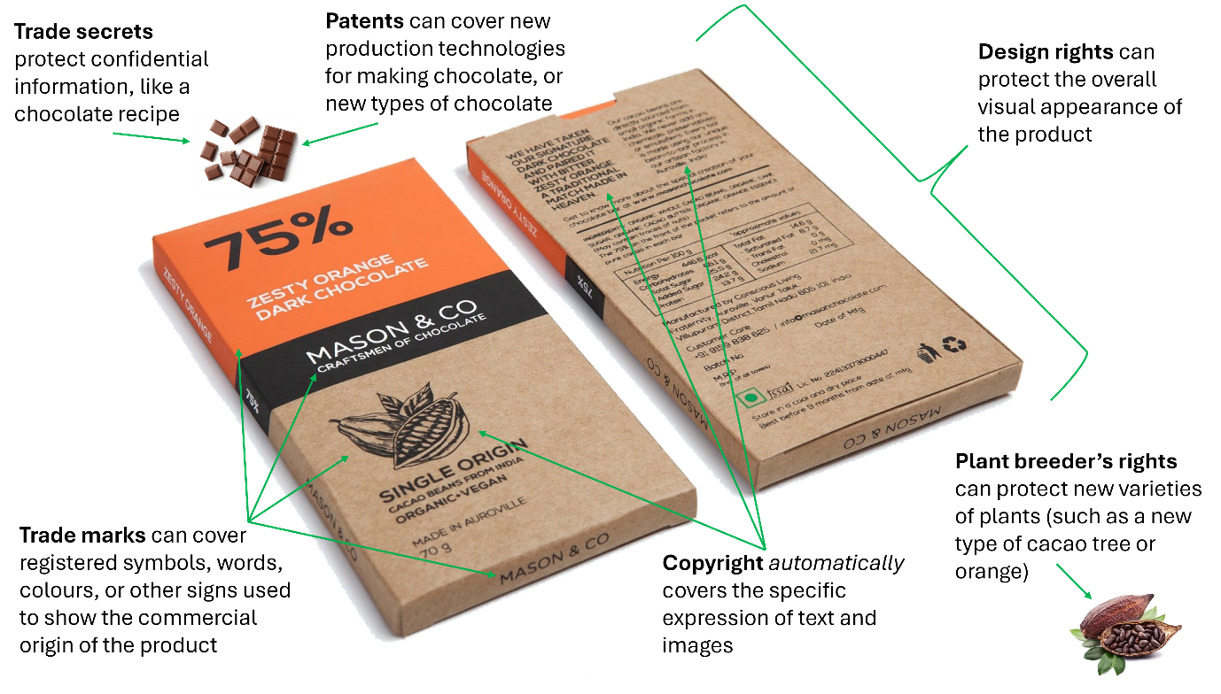
- Copyright protects creative expressions, including writing, images, and computer code. Copyright automatically covers original creative works, until 70 years after the death of the author.
- Patent protects inventions which are novel, useful, and which contain an inventive step. They provide strong protection for a period of 20 years, but are expensive and complex.
- Trade marks protect signs indicating a brand or commercial origin.
- Trade secrets protect confidential information about a business.
- Design rights protect the overall visual appearance of a physical product.
- Plant breeder’s rights protect new varieties of plants.
Summary
| Type of IP | What is Protected | Cost | Timeline for Grant | Duration | Strategic Considerations |
| Copyright | Specific creative expressions | Free | No grant required | 70 years after the death of the author | Only protects the specific expression (only prevents direct copying) |
| Patents | Inventions which are novel, useful, and non-obvious. | $10,000 -$20,000 | 6 months to several years | 20 years | Provides strong protection over an invention |
| Trade marks | Distinctive symbols (including words, sounds, colours, etc.) associated with a brand | Minimum $250 filing fees (not including lawyer fees) | Minimum 7 months | 10 years per registration, can be renewed indefinitely | Provides powerful and indefinitely
Only protects within categories of goods or services for which it is registered |
| Trade secrets | Confidential information
Breach of confidence is a legal action which provides protection when secrets are leaked |
Practical costs of secrecy | No grant required | No limit, unless secret becomes public | For legal protection to be available, secrecy measures must be in place |
| Design rights | The overall visual appearance of a whole physical product | Minimum $250 filing fee; lawyer fees ~$1000 | Within 6 months | 5 years, with the option of renewal for an additional 5 years | Provides quite limited protection over a specific design |
| Plant Breeder’s Rights | New varieties of plants | $3000+ | 2 to 3 years | 20 years (25 for trees and some vines) | Only covers plant varieties |
References
Back to menu Introduction to Intellectual Property PDF